
By Jaco Grobbelaar on Tue, Nov 17, 2026 @ 10:12 AM

Most businesses believe the Marketing Engine ends once they can reliably generate leads, convert opportunities, and measure performance.
After all, if your positioning is clear, your demand generation programs are working, and your analytics are helping you improve results, what else is left?
Quite a lot, actually.
One of the biggest growth opportunities in your business sits beyond lead generation, conversion rates, and campaign performance. It exists within your current customer base.
Yet this is the stage many companies overlook.
Once a deal is closed, marketing moves on to the next campaign, sales focuses on the next opportunity, and customer relationships are often viewed through the lens of service delivery rather than growth. The assumption is that the hard work is done.
In reality, this is where some of the most valuable growth opportunities begin.
That's why Lifecycle & Expansion is the eighth and final component of the Marketing Engine. It's the stage that transforms satisfied customers into advocates, advocates into referrals, and referrals into new demand. In other words, it turns the end of the customer journey into the beginning of the next growth cycle.
The businesses that grow most efficiently aren't always the ones spending the most on marketing. Often, they're the ones who have figured out how to turn customer success into a repeatable source of new opportunities.
Why Customer Advocacy Matters More Than Ever
Imagine two companies selling a similar service.
The first spends thousands of dollars each month on advertising, content creation, events, and outbound prospecting to generate new opportunities.
The second does all of those things too, but there's one difference. Their customers leave reviews, introduce them to peers, participate in case studies, and recommend them within their professional networks.
Which company has the stronger growth engine?
It’s an obvious answer: the second company.
Yet many organizations still treat customer advocacy as something that's nice to have rather than something that should be built intentionally.
The reality is that trust has become one of the most valuable assets in modern marketing. Buyers have more choices, more information, and more noise competing for their attention than ever before. When they're evaluating potential vendors, they're not just looking for claims on a website or promises in a sales presentation. They're looking for proof.
That's why referrals carry so much weight. A referral is more than a lead. It's a transfer of trust. Someone has effectively told a colleague, friend, or peer, "We've worked with this company, and we'd be comfortable putting our reputation behind them."
That's a powerful endorsement.
Think about the last significant purchase your business made. Whether it was software, legal support, consulting services, or a strategic partner, there's a good chance recommendations played a role in the decision. Most buyers don't start by asking, "Who has the best marketing?" They start by asking, "Who do you recommend?"
This is what makes customer advocacy such an important growth channel. It allows businesses to turn successful customer relationships into future demand. Instead of constantly fighting for attention, they benefit from something far more valuable: credibility that has already been earned.
The challenge is that many companies leave this entirely to chance. They celebrate referrals when they happen, but they rarely create systems that encourage them. As a result, some of their greatest growth opportunities remain hidden within their existing customer base.
Where Advocacy Fits in the Marketing Engine
To understand why customer advocacy matters, it helps to look at the broader Marketing Engine.
The first seven components of the engine are designed to attract, engage, convert, and optimize:
- Positioning & Messaging
- Demand Generation
- Content Development & Distribution
- Conversion Architecture
- Sales Enablement
- Marketing Operations & Automation
- Analytics, Optimization & Continuous Improvement
Together, these components create a predictable system for generating growth. They help organizations attract the right audience, guide prospects through the buying process, and continuously improve performance over time.
What many companies don’t recognize is that the engine shouldn't stop there.
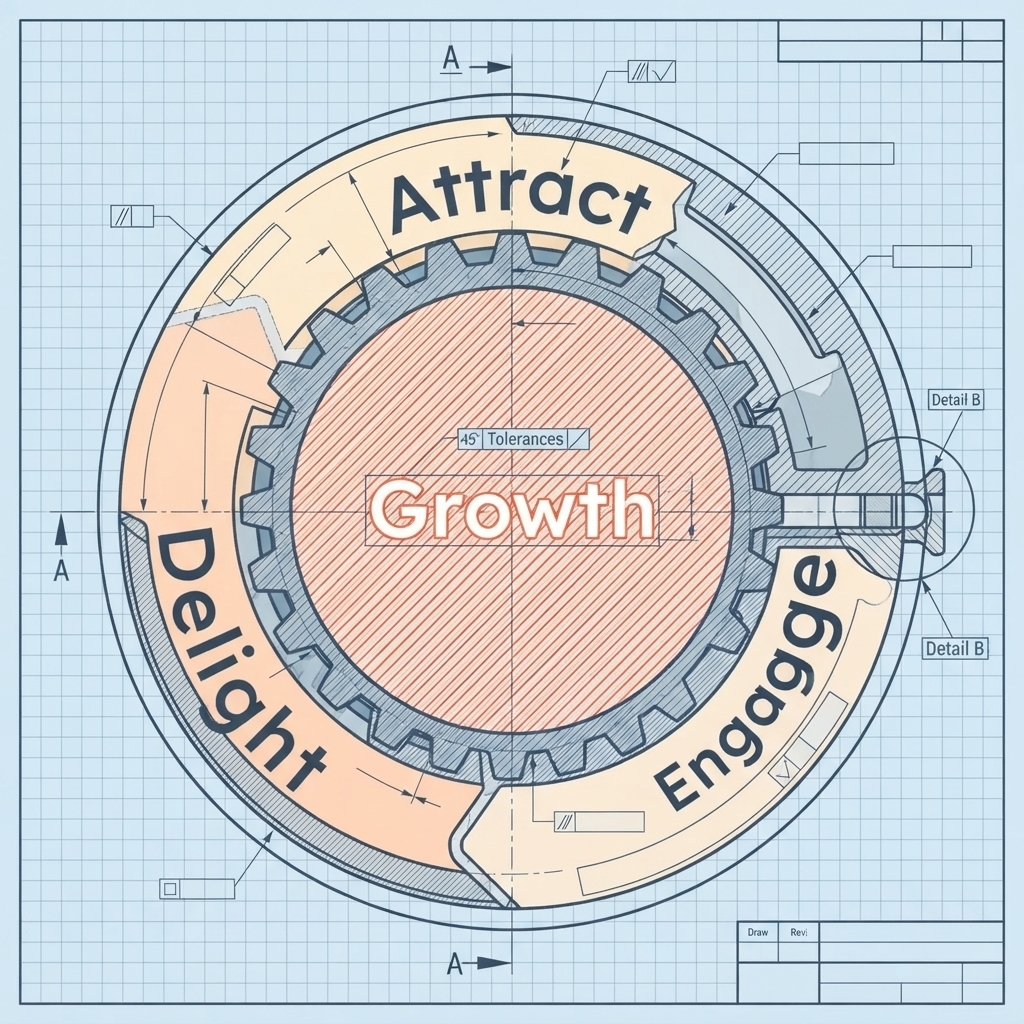
Lifecycle & Expansion exists because growth isn’t a linear process. It's cyclical. Every customer interaction creates an opportunity to strengthen relationships, increase loyalty, expand engagement, and encourage advocacy.
This is why we often encourage clients to think beyond the traditional funnel model. Funnels have an endpoint. Once a prospect becomes a customer, the journey is complete.
A true growth engine behaves more like a flywheel.
When customers achieve success, they become more likely to renew, expand their relationship, share their experiences, and recommend your business to others. Those referrals create new demand, which feeds directly back into the top of the engine. The result is a self-reinforcing cycle where successful customer relationships contribute to future growth.
What Is the Difference Between a Customer and an Advocate?
Many organizations assume that customer satisfaction automatically leads to referrals.
Unfortunately, it doesn't.
Most satisfied customers simply continue doing business with you. They pay their invoices, renew their agreements, and appreciate the value you provide. While that is certainly positive, it is not the same as advocacy.
An advocate is someone who actively promotes your business. They introduce you to colleagues, recommend you within their professional network, participate in case studies, leave reviews, and share positive experiences with others.
The distinction may seem subtle, but it matters.
Think about the vendors and service providers you work with. There are probably several companies you are happy with, but only a select few that you enthusiastically recommend when someone asks for advice. Those organizations have likely delivered more than a service. They've created trust, demonstrated consistent results, and provided an experience worth talking about.
Customer advocacy happens when customers feel confident attaching their reputation to your business. In other words, they trust that anyone they refer will receive the same positive experience they had.
That level of confidence cannot be manufactured. It must be earned through consistent delivery and meaningful outcomes.
Why Referrals Generate Better Opportunities
Not all leads enter the sales process under the same conditions.
A prospect who discovers your business through a paid advertisement may know very little about your organization. They are still evaluating options, comparing alternatives, and determining whether they trust your claims.
A referred prospect starts from a completely different position.
Someone they trust has already done part of the evaluation for them. They have heard a real success story from a credible source, and they often enter the relationship with greater confidence and clarity.
As a result, referral-generated opportunities frequently offer several advantages:
- Higher levels of trust
- Better qualification
- Shorter sales cycles
- Lower acquisition costs
- Stronger conversion rates
This doesn't mean referral marketing should replace other growth strategies. Demand generation, content marketing, and sales enablement remain critical components of the Marketing Engine.
Instead of replacing them, advocacy should amplify those efforts.
The goal is not to choose between marketing and referrals. The goal is to create a system where both work together. Effective demand generation attracts new audiences, while customer advocacy strengthens credibility and accelerates decision-making.
How to Build a Customer Advocacy Program
The best customer advocacy programs aren't complicated. They create a repeatable process for turning customer success into referrals, testimonials, reviews, and introductions.
Step 1: Identify Your AdvocatesStart with customers who are seeing strong results and regularly engage with your team. If a client is achieving measurable value and speaks positively about your business, they're likely a strong candidate for advocacy. |
Step 2: Create Moments Worth SharingReferrals are most likely to happen after a meaningful win. A successful project, measurable ROI, or major milestone creates a natural opportunity for customers to talk about their experience. |
Step 3: Ask at the Right TimeMany businesses simply don't ask. When customers are experiencing success, make it easy for them to provide a testimonial, leave a review, or introduce you to someone in their network. |
Step 4: Capture Customer StoriesCase studies, testimonials, and success stories help turn individual customer wins into assets that support future demand generation. They also give advocates a platform to share their experiences. |
Step 5: Remove FrictionEven happy customers are busy. Make advocacy easy by providing simple review links, referral templates, or clear next steps for participation. |
Step 6: Track and Measure What WorksTrack referrals, reviews, testimonials, and customer-generated opportunities just as you would any other marketing channel. Over time, you'll identify patterns that help strengthen your advocacy efforts. |
The goal isn't to create a one-off referral campaign. It's to build a system that consistently turns customer success into future growth.
Common Mistakes Businesses Make
Most businesses don't deliberately ignore customer advocacy.
They simply assume it will take care of itself.
It's a bit like planting a garden, watering it once, and then being surprised six months later when nothing has grown. While some referrals will happen naturally, relying entirely on chance means leaving one of your most valuable growth channels to luck.
One of the biggest mistakes companies make is treating the customer relationship as "mission accomplished." Once the deal is signed, attention shifts back to lead generation, pipeline growth, and the next sales opportunity. Meanwhile, the customers who already trust your business receive very little strategic attention beyond service delivery.
Another common trap is waiting for the perfect moment to ask for a referral or testimonial. The reality is that the perfect moment often comes and goes. A client achieves a great result, celebrates a successful project, tells your team how happy they are… but nobody asks. Six months later, the enthusiasm has faded, and the opportunity is much harder to recreate.
Many organizations also fall into the habit of measuring everything except advocacy. They can tell you their website traffic, conversion rate, cost per lead, and pipeline value, but have no idea how many referrals they generated last quarter or where those referrals came from. If customer advocacy is a growth channel, it deserves the same attention and measurement as any other marketing initiative.
The businesses that generate referrals consistently aren't necessarily delivering dramatically better work than everyone else. More often, they're simply more intentional. They identify advocates, create opportunities for participation, and make customer advocacy part of the growth strategy rather than something they hope will happen on its own.
Ready to Unlock the Growth Potential Within Your Customer Base?
Many organizations spend significant resources generating new leads while overlooking one of their most valuable assets: existing customer relationships.
If you're ready to strengthen retention, create expansion opportunities, and build a system that turns satisfied clients into advocates, explore BroadVision Marketing's Lifecycle & Expansion services and discover how the final stage of the Marketing Engine can fuel the next phase of growth.
About BVM
BroadVision Marketing helps organizations build predictable growth through a comprehensive Marketing Engine that aligns strategy, execution, technology, and customer lifecycle management. By connecting every stage of the customer journey, businesses can create sustainable growth that extends beyond acquisition.
Still Relying on Referrals? Build a Demand Generation Engine That Scales
The Hidden Growth Killer: When Marketing and Sales Aren’t Aligned

No Comments Yet
Let us know what you think